Have you ever spotted a colourful butterfly in your garden, watched ants carrying food, or heard a cricket chirping at night? We see insects almost everywhere, but do you know what these little creatures are called in Hindi and English?
Learning insect names is useful for children, students and anyone interested in improving their Hindi and English vocabulary. Some insects are beautiful, some help plants grow, and others play important roles in maintaining nature.
In this article, you will learn the names of common insects in Hindi and English, their pronunciation, interesting facts and the Hindi meaning of the word insect.
What Is Insect Called in Hindi?
The word Insect is translated as कीट (Keet) in Hindi. In everyday conversation, people commonly use कीड़ा (Keeda).
The plural word Insects is commonly expressed as कीड़े (Keede) or कीट (Keet), depending on the context.
For example:
- Insect – कीट (Keet) / कीड़ा (Keeda)
- Insects – कीड़े (Keede)
- Insect names – कीड़ों के नाम (Keedon Ke Naam)
Insects are small animals belonging to a group called arthropods. They have six legs, a pair of antennae and three main body sections: the head, thorax and abdomen.
Ants, butterflies, mosquitoes, honeybees and cockroaches are all examples of insects.
Insects Name in Hindi and English (kido ke naam)
Here is a list of commonly known insects with their Hindi names and English pronunciation. These include insects that you may see around your home, garden, school or farm.
| Sr. No. | English Name | Hindi Name | Pronunciation |
|---|---|---|---|
| 1 | Ant | चींटी | Cheenti |
| 2 | Butterfly | तितली | Titli |
| 3 | Honeybee | मधुमक्खी | Madhumakkhi |
| 4 | Housefly | मक्खी | Makkhi |
| 5 | Mosquito | मच्छर | Machhar |
| 6 | Cockroach | तिलचट्टा | Tilchatta |
| 7 | Grasshopper | टिड्डा | Tिड्डा |
| 8 | Dragonfly | व्याध पतंग | Vyadh Patang |
| 9 | Termite | दीमक | Deemak |
| 10 | Firefly | जुगनू | Jugnu |
| 11 | Cricket | झींगुर | Jhingur |
| 12 | Moth | पतंगा | Patanga |
| 13 | Caterpillar | इल्ली | Illi |
| 14 | Wasp | ततैया | Tataiya |
| 15 | Bedbug | खटमल | Khatmal |
| 16 | Flea | पिस्सू | Pissu |
| 17 | Louse | जूँ | Joon |
| 18 | Beetle | भृंग | Bhring |
| 19 | Ladybird | गुबरैला | Gubarela |
| 20 | Silkworm | रेशम का कीड़ा | Resham Ka Keeda |
| 21 | Aphid | माहू | Mahu |
| 22 | Whitefly | सफेद मक्खी | Safed Makkhi |
| 23 | Fruit Fly | फल मक्खी | Phal Makkhi |
| 24 | Locust | टिड्डी दल का कीट | Tiddi Dal Ka Keet |
| 25 | Bumblebee | भौंरा | Bhaunra |
| 26 | Hornet | बर्रा | Barra |
| 27 | Cicada | सिकाडा | Cicada |
| 28 | Weevil | घुन | Ghun |
| 29 | Praying Mantis | प्रेइंग मैन्टिस | Praying Mantis |
| 30 | Lac Insect | लाख कीट | Lakh Keet |
Note: Some insect names have regional variations. For less familiar species, Hindi scientific or descriptive names may be used alongside commonly understood English names. A few are commonly written in Hindi using their English pronunciation.
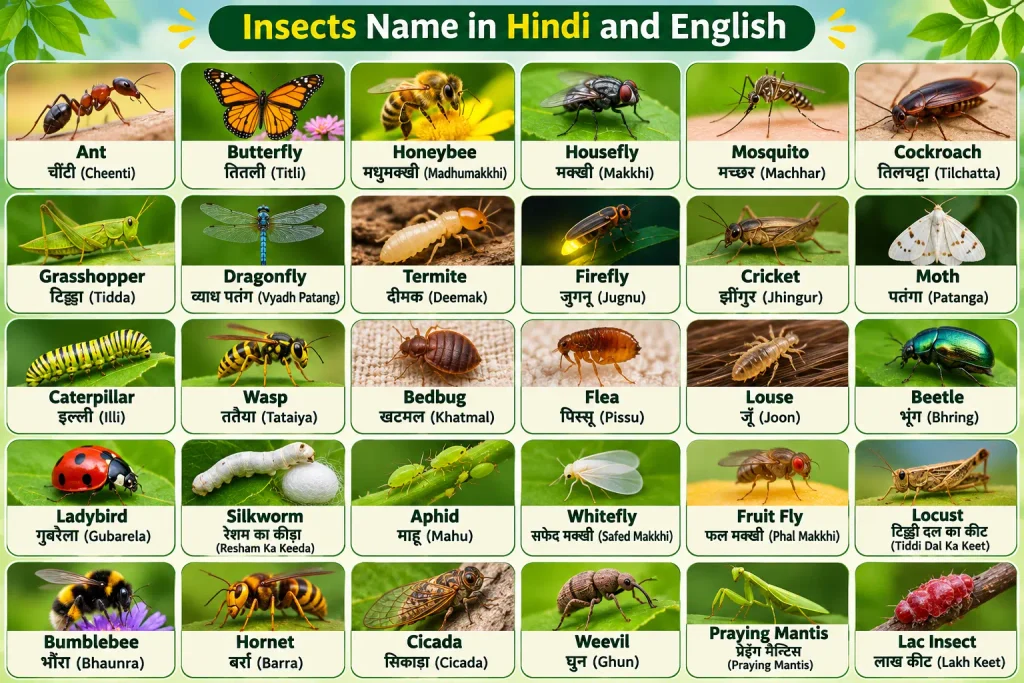
Common Insects Found Around Us
Knowing an insect’s name is useful, but understanding what it does makes learning more interesting. Here are some familiar insects and a few facts about each.
1. Ant (चींटी)
Ants are small social insects that usually live together in colonies. You may often see them walking in a line while carrying food.
They communicate using chemical signals called pheromones. Different ants in a colony perform different tasks, such as collecting food, protecting the nest and caring for young ants.
Interesting fact: Some ants can carry objects many times heavier than their own body weight.
2. Butterfly (तितली)
Butterflies are among the most colourful insects. They have large wings covered with tiny scales, which create their beautiful patterns and colours.
They usually feed on nectar from flowers using a long, tube-like mouthpart called a proboscis. Butterflies also help pollinate plants while moving between flowers.
Interesting fact: Butterflies develop through four stages: egg, caterpillar, pupa and adult butterfly.
3. Honeybee (मधुमक्खी)
Honeybees are important insects because they help pollinate flowers and agricultural crops. They collect nectar and pollen, which they use as food and to produce honey.
Honeybees generally live in organised colonies containing a queen, worker bees and drones.
Interesting fact: Honeybees communicate the location of food sources to other bees through a special movement known as the waggle dance.
4. Mosquito (मच्छर)
Mosquitoes are small flying insects commonly found near places where water collects.
Female mosquitoes of certain species can transmit diseases such as dengue, malaria and chikungunya. Removing stagnant water around homes is an important way to reduce mosquito breeding.
Interesting fact: Only female mosquitoes take blood meals. They need the nutrients to develop their eggs.
5. Housefly (मक्खी)
Houseflies are commonly seen around kitchens, garbage and food waste. They can transfer germs from contaminated surfaces to food.
Keeping food covered, cleaning waste regularly and maintaining kitchen hygiene can help reduce houseflies.
Interesting fact: Houseflies taste using receptors on their feet.
6. Cockroach (तिलचट्टा)
Cockroaches are insects that can survive in a variety of environments. They are commonly found in warm, dark and damp places such as kitchens, drains and storage areas.
They feed on different types of organic material, including food scraps.
Interesting fact: Cockroaches use their antennae to sense their surroundings and locate food.
7. Dragonfly (व्याध पतंग)
Dragonflies are fast-flying insects often seen near ponds, lakes and other water bodies.
They have large eyes and two pairs of transparent wings. Both adult dragonflies and their young aquatic stages hunt smaller insects.
Interesting fact: Dragonflies are skilled flyers and can move forwards, backwards and hover in the air.
8. Grasshopper (टिड्डा)
Grasshoppers are plant-eating insects known for their strong hind legs, which help them jump long distances.
They are commonly found in grasslands, gardens and agricultural fields. Some species can become serious crop pests when their populations increase.
Interesting fact: Grasshoppers produce sounds by rubbing body parts together or by other specialised mechanisms, depending on the species.
9. Firefly (जुगनू)
Fireflies are known for the light they produce, especially during the evening and night.
This light is generated through a natural chemical reaction called bioluminescence. Fireflies use light signals to communicate, particularly when finding mates.
Interesting fact: Fireflies are actually beetles, not flies.
10. Termite (दीमक)
Termites are social insects that feed mainly on materials containing cellulose, such as wood and dead plant matter.
They help break down organic material in nature. However, some species can damage wooden furniture, doors and buildings.
Interesting fact: Termites live in colonies and work together to build and maintain their nests.
11. Cricket (झींगुर)
Crickets are insects known for their chirping sounds, which are particularly noticeable at night.
Male crickets usually produce these sounds by rubbing their wings together. They use the sounds to attract females and communicate with other crickets.
Interesting fact: Crickets have long antennae that help them sense their surroundings.
12. Moth (पतंगा)
Moths are closely related to butterflies and belong to the same insect order, Lepidoptera.
Many moths are active at night and are attracted to artificial lights. Their wings often have patterns that help them camouflage themselves.
Interesting fact: Like butterflies, moths develop through egg, caterpillar, pupa and adult stages.
Insect Names in Hindi for Kids
Learning insect names can be a fun activity for children. Start with familiar insects that they may see in gardens, parks or around their homes.
| English Name | Hindi Name |
|---|---|
| Ant | चींटी |
| Butterfly | तितली |
| Honeybee | मधुमक्खी |
| Mosquito | मच्छर |
| Housefly | मक्खी |
| Cockroach | तिलचट्टा |
| Grasshopper | टिड्डा |
| Dragonfly | व्याध पतंग |
| Firefly | जुगनू |
| Termite | दीमक |
Try this activity: Ask children to find five insects in a picture book or garden. Let them write the English name, Hindi name and one interesting fact about each insect.
This helps children remember the names instead of simply memorising a list.
Different Types of Insects
Scientists classify insects into different groups based on their physical characteristics and evolutionary relationships.
Here are some important insect groups with familiar examples.
| Insect Group | Examples | Key Characteristics |
|---|---|---|
| Lepidoptera | Butterflies and moths | Wings covered with tiny scales |
| Coleoptera | Beetles and ladybirds | Usually have hardened front wings |
| Diptera | Houseflies and mosquitoes | One pair of functional wings |
| Hymenoptera | Ants, bees and wasps | Includes many social and pollinating insects |
| Orthoptera | Grasshoppers and crickets | Often have strong hind legs for jumping |
| Hemiptera | Aphids and true bugs | Many have piercing and sucking mouthparts |
| Odonata | Dragonflies and damselflies | Large eyes and two pairs of wings |
Why Are Insects Important?
Although insects are small, they perform several important functions that help maintain a healthy environment.
1. Pollination
Bees, butterflies and other insects transfer pollen between flowers. This helps plants reproduce and supports the production of many fruits and vegetables.
2. Natural pest control
Some insects feed on other insects that damage plants. Ladybirds, for example, eat aphids, which are common garden pests.
3. Decomposition
Termites and certain beetles help break down dead plants and organic material. This supports nutrient recycling in the environment.
4. Food for other animals
Many birds, frogs, reptiles and other animals depend on insects as a source of food.
5. Soil health
Some insects help mix organic material into the soil and contribute to the natural recycling of nutrients.
Insects are not always beneficial to humans. Some damage crops, infest stored food or spread diseases. However, their contribution to the environment is essential.
Difference Between Insects and Other Small Creatures
Not every small creature that crawls or flies is an insect. Some animals are commonly called bugs or insects in everyday conversations, but they belong to different scientific groups.
| Creature | Hindi Name | Is It an Insect? |
|---|---|---|
| Spider | मकड़ी | No – Arachnid |
| Scorpion | बिच्छू | No – Arachnid |
| Centipede | कनखजूरा | No – Myriapod |
| Millipede | सहस्रपाद | No – Myriapod |
| Earthworm | केंचुआ | No – Annelid |
| Snail | घोंघा | No – Mollusc |
The easiest way to identify a typical adult insect is to look for six legs and three main body sections. Spiders, for example, have eight legs and therefore are not insects.
Frequently Asked Questions About Insects
The Hindi meaning of insect is कीट (Keet). In everyday conversations, people also commonly use कीड़ा (Keeda).
Insects are called कीड़े (Keede) or कीट (Keet) in Hindi. Examples include चींटी (Ant), तितली (Butterfly), मधुमक्खी (Honeybee) and मच्छर (Mosquito).
Ten common insects are ants, butterflies, honeybees, mosquitoes, houseflies, cockroaches, grasshoppers, dragonflies, fireflies and termites.
A cockroach is called तिलचट्टा (Tilchatta) in Hindi.
A butterfly is called तितली (Titli) in Hindi.
A mosquito is called मच्छर (Machhar) in Hindi.
A honeybee is called मधुमक्खी (Madhumakkhi) in Hindi.
A moth is commonly called पतंगा (Patanga) in Hindi.
Insects have six legs arranged in three pairs. All six legs are attached to the thorax.
No. Spiders belong to the arachnid group. They have eight legs, whereas insects have six legs.
Honeybees produce honey by collecting nectar from flowers and processing it inside their colonies.
Fireflies produce light through a natural process called bioluminescence.
Bees, butterflies, moths and some beetles and flies help pollinate flowering plants.
In everyday language, people use the word bug for many small creatures. Scientifically, true bugs belong to a particular insect order called Hemiptera. All true bugs are insects, but not all insects are true bugs.
Children commonly learn the phrase कीड़ों के नाम (Keedon Ke Naam). Examples include चींटी, तितली, मधुमक्खी, मच्छर and मक्खी.


