Flowers are one of the most beautiful parts of nature. They come in different shapes, sizes, colours and fragrances. Some flowers grow in gardens, while others are found in forests, mountains, wetlands and fields. Many are also used for decoration, worship, perfumes and medicines.
Learning the names of flowers in English is useful for children, students and anyone interested in nature. Below is a list of 100+ flower names, including common flowers, Indian flowers, garden flowers and some unusual varieties, along with their botanical names.
100+ Flowers Name in English
Here is a list of popular and less commonly known flowers with their English and botanical names.
| No. | Flower Name | Botanical Name |
|---|---|---|
| 1 | Rose | Rosa spp. |
| 2 | Lotus | Nelumbo nucifera |
| 3 | Sunflower | Helianthus annuus |
| 4 | Marigold | Tagetes spp. |
| 5 | Jasmine | Jasminum spp. |
| 6 | Hibiscus | Hibiscus rosa-sinensis |
| 7 | Lily | Lilium spp. |
| 8 | Daisy | Bellis perennis |
| 9 | Tulip | Tulipa spp. |
| 10 | Orchid | Orchidaceae |
| 11 | Lavender | Lavandula angustifolia |
| 12 | Dahlia | Dahlia spp. |
| 13 | Chrysanthemum | Chrysanthemum spp. |
| 14 | Poppy | Papaver spp. |
| 15 | Daffodil | Narcissus spp. |
| 16 | Carnation | Dianthus caryophyllus |
| 17 | Magnolia | Magnolia spp. |
| 18 | Bougainvillea | Bougainvillea spp. |
| 19 | Tuberose | Agave amica |
| 20 | Gerbera | Gerbera jamesonii |
| 21 | Petunia | Petunia × atkinsiana |
| 22 | Zinnia | Zinnia elegans |
| 23 | Gladiolus | Gladiolus spp. |
| 24 | Plumeria | Plumeria spp. |
| 25 | Periwinkle | Catharanthus roseus |
| 26 | Morning Glory | Ipomoea purpurea |
| 27 | Bluebell | Hyacinthoides non-scripta |
| 28 | Pansy | Viola × wittrockiana |
| 29 | Aster | Aster spp. |
| 30 | Peony | Paeonia spp. |
| 31 | Hydrangea | Hydrangea macrophylla |
| 32 | Gardenia | Gardenia jasminoides |
| 33 | Freesia | Freesia spp. |
| 34 | Calendula | Calendula officinalis |
| 35 | Cosmos | Cosmos bipinnatus |
| 36 | Begonia | Begonia spp. |
| 37 | Sweet Pea | Lathyrus odoratus |
| 38 | Foxglove | Digitalis purpurea |
| 39 | Snapdragon | Antirrhinum majus |
| 40 | Forget-me-not | Myosotis spp. |
| 41 | Wisteria | Wisteria sinensis |
| 42 | Clematis | Clematis spp. |
| 43 | Ranunculus | Ranunculus asiaticus |
| 44 | Anemone | Anemone coronaria |
| 45 | Blue Poppy | Meconopsis betonicifolia |
| 46 | Coneflower | Echinacea purpurea |
| 47 | Black-eyed Susan | Rudbeckia hirta |
| 48 | Delphinium | Delphinium spp. |
| 49 | Hollyhock | Alcea rosea |
| 50 | Hyacinth | Hyacinthus orientalis |
| 51 | Crocus | Crocus spp. |
| 52 | Cyclamen | Cyclamen persicum |
| 53 | Violet | Viola odorata |
| 54 | Snowdrop | Galanthus nivalis |
| 55 | Buttercup | Ranunculus spp. |
| 56 | Cornflower | Centaurea cyanus |
| 57 | Foxglove | Digitalis purpurea |
| 58 | Phlox | Phlox spp. |
| 59 | Verbena | Verbena spp. |
| 60 | Lobelia | Lobelia erinus |
| 61 | Ixora | Ixora coccinea |
| 62 | Lantana | Lantana camara |
| 63 | Crossandra | Crossandra infundibuliformis |
| 64 | Canna Lily | Canna indica |
| 65 | Balsam | Impatiens balsamina |
| 66 | Touch-me-not | Mimosa pudica |
| 67 | Flame of the Forest (Palash) | Butea monosperma |
| 68 | Gulmohar | Delonix regia |
| 69 | Golden Shower (Amaltas) | Cassia fistula |
| 70 | Parijat | Nyctanthes arbor-tristis |
| 71 | Champak | Magnolia champaca |
| 72 | Indian Coral Tree | Erythrina variegata |
| 73 | Kachnar | Bauhinia variegata |
| 74 | Ashoka Flower | Saraca asoca |
| 75 | Indian Cork Tree | Millingtonia hortensis |
| 76 | Aparajita (Butterfly Pea) | Clitoria ternatea |
| 77 | Mogra (Arabian Jasmine) | Jasminum sambac |
| 78 | Night-blooming Jasmine | Cestrum nocturnum |
| 79 | Indian Rosewood Flower | Dalbergia sissoo |
| 80 | Kadamba | Neolamarckia cadamba |
| 81 | Indian Laburnum | Cassia fistula |
| 82 | Brahma Kamal | Saussurea obvallata |
| 83 | Nagalinga Flower | Couroupita guianensis |
| 84 | Rangoon Creeper | Combretum indicum |
| 85 | Crown Flower | Calotropis gigantea |
| 86 | Indian Coral Jasmine | Nyctanthes arbor-tristis |
| 87 | Tithonia (Mexican Sunflower) | Tithonia diversifolia |
| 88 | Bird of Paradise | Strelitzia reginae |
| 89 | Passion Flower | Passiflora incarnata |
| 90 | Bleeding Heart | Lamprocapnos spectabilis |
| 91 | Bird’s Foot Trefoil | Lotus corniculatus |
| 92 | Edelweiss | Leontopodium nivale |
| 93 | Protea | Protea spp. |
| 94 | Kangaroo Paw | Anigozanthos spp. |
| 95 | Chocolate Cosmos | Cosmos atrosanguineus |
| 96 | Queen Anne’s Lace | Daucus carota |
| 97 | Morning Star Flower | Ipomoea spp. |
| 98 | Globe Amaranth | Gomphrena globosa |
| 99 | Tansy | Tanacetum vulgare |
| 100 | Yarrow | Achillea millefolium |
| 101 | Hellebore | Helleborus spp. |
| 102 | Allium | Allium spp. |
| 103 | Kangaroo Paw | Anigozanthos spp. |
| 104 | Calla Lily | Zantedeschia aethiopica |
| 105 | Alstroemeria | Alstroemeria spp. |
Note: Some common flower names refer to multiple species, so their botanical names are given at the genus level. The list includes both flowering plants and flowers commonly recognized by their familiar English names.
Common Flowers Found in India
India has a wide variety of flowering plants that grow in gardens, parks, forests and natural landscapes. Some are especially popular because of their fragrance, colourful blooms or cultural importance.
Here are some well-known flowers found in India:
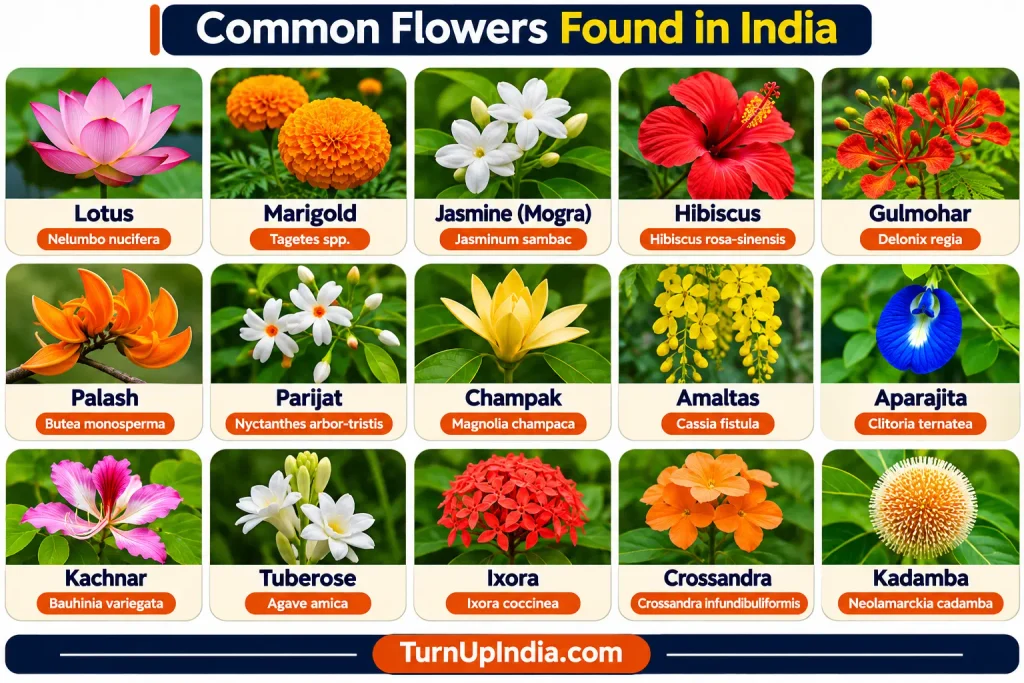
| Flower Name | Botanical Name | Common Use or Feature |
|---|---|---|
| Lotus | Nelumbo nucifera | National flower of India |
| Marigold | Tagetes spp. | Garlands and decorations |
| Jasmine (Mogra) | Jasminum sambac | Fragrance and perfumes |
| Hibiscus | Hibiscus rosa-sinensis | Gardens and worship |
| Gulmohar | Delonix regia | Ornamental roadside tree |
| Palash | Butea monosperma | Bright orange-red forest flowers |
| Parijat | Nyctanthes arbor-tristis | Fragrant night-blooming flowers |
| Champak | Magnolia champaca | Fragrance and traditional uses |
| Amaltas | Cassia fistula | Yellow hanging flower clusters |
| Aparajita | Clitoria ternatea | Blue and white flowers |
| Kachnar | Bauhinia variegata | Pink and white blossoms |
| Tuberose | Agave amica | Fragrant flowers used in garlands |
| Ixora | Ixora coccinea | Bright clusters of small flowers |
| Crossandra | Crossandra infundibuliformis | Orange ornamental flowers |
| Kadamba | Neolamarckia cadamba | Round clusters of fragrant flowers |
Different Types of Flowers
Flowers can be grouped according to their appearance, growing habits and natural characteristics. Here are some common categories with examples.
1. Fragrant Flowers
These flowers are known for their pleasant fragrance and are often used in perfumes, garlands and decorations.
Examples: Rose, Jasmine, Lavender, Tuberose and Gardenia.
2. Seasonal Flowers
These flowers bloom during particular seasons depending on the climate and growing conditions.
Examples: Marigold, Petunia, Pansy, Zinnia and Chrysanthemum.
3. Wild Flowers
Wild flowers grow naturally in forests, grasslands, mountains and other habitats without being deliberately planted.
Examples: Blue Poppy, Cornflower, Edelweiss, Buttercup and Forget-me-not.
4. Ornamental Flowers
These flowers are commonly grown in gardens, parks and homes because of their attractive appearance.
Examples: Dahlia, Gerbera, Orchid, Tulip and Bougainvillea.
10 Interesting Facts About Flowers
- Lotus: The lotus is the national flower of India and grows in water.
- Sunflower: Young sunflowers can track the movement of the Sun across the sky.
- Rafflesia: Rafflesia arnoldii produces one of the largest individual flowers in the world.
- Titan Arum: Also called the corpse flower, it produces a strong smell similar to rotting flesh.
- Tulip: Tulips became extremely popular during a period of intense speculation known as Tulip Mania in the Netherlands.
- Jasmine: Jasmine flowers are widely used in perfumes because of their pleasant fragrance.
- Marigold: Marigolds are commonly used in Indian festivals, weddings and religious decorations.
- Bamboo: Some bamboo species flower only after many decades.
- Night-blooming Flowers: Certain flowers, such as night-blooming jasmine, release their fragrance mainly after sunset.
- Orchids: Orchids are one of the largest families of flowering plants, with tens of thousands of recognized species.
Frequently Asked Questions About Flowers
Rose, Lotus, Sunflower, Marigold, Jasmine, Hibiscus, Lily, Daisy, Tulip and Orchid are ten commonly known flower names.
The lotus (Nelumbo nucifera) is the national flower of India. It grows in ponds, lakes and other freshwater habitats.
Rafflesia arnoldii produces one of the largest individual flowers in the world. Its flower can grow to approximately one metre in diameter.
Rose, Marigold, Hibiscus, Jasmine, Bougainvillea, Chrysanthemum, Periwinkle and Crossandra are commonly grown in Indian gardens.
Jasmine, Rose, Lavender, Gardenia, Tuberose and Champak are well-known fragrant flowers.
A flower is the reproductive structure of a flowering plant. A flowering plant is the entire plant, including its roots, stems, leaves and flowers.